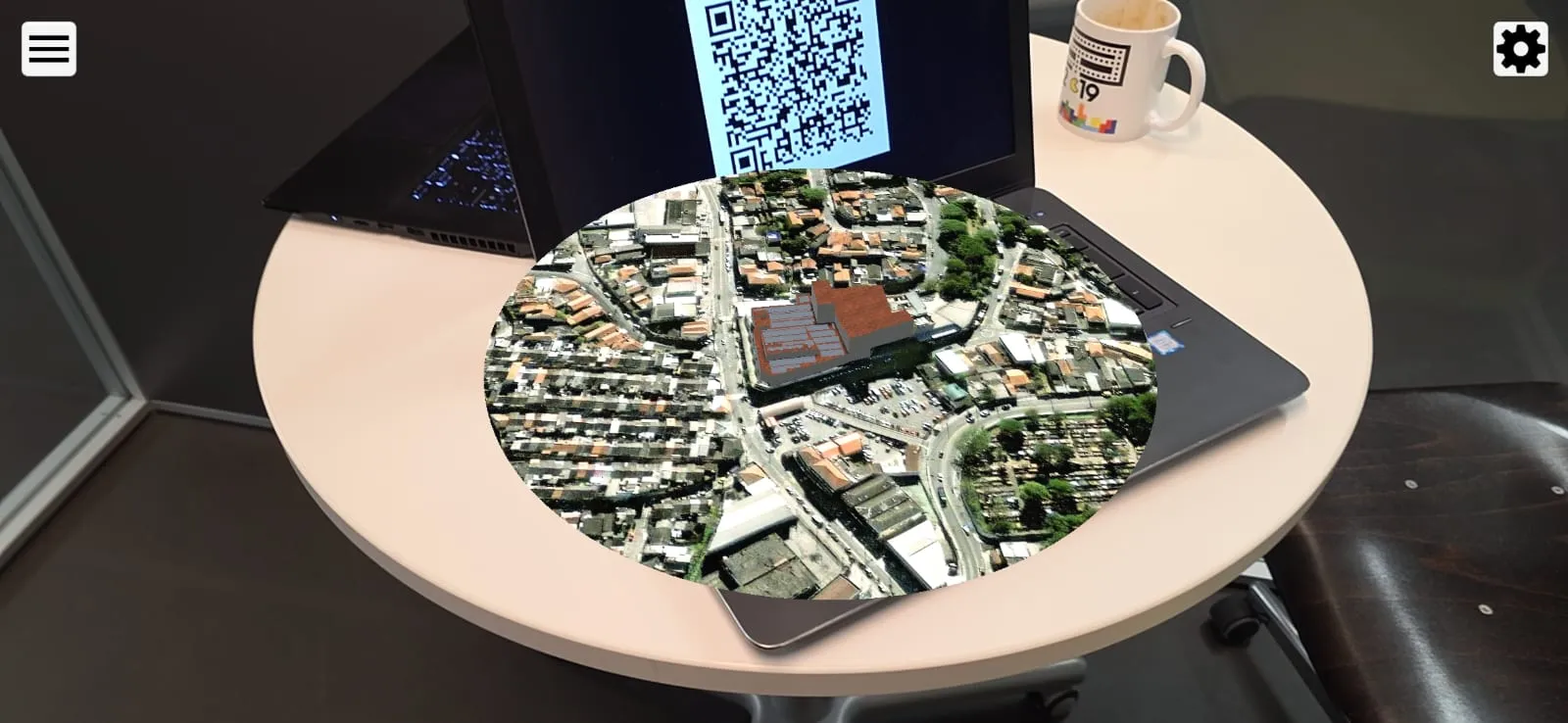
The AR app showing a project on a tabletop
Static 2D renderings and basic 3D viewers make it hard to show a client what a solar installation will actually look like: shading through the day, how panels sit on the roof, how a layout reads at scale. I worked with Solextron AG on AR and VR apps for viewing and configuring solar panel layouts, connected to their existing web-based design tool.
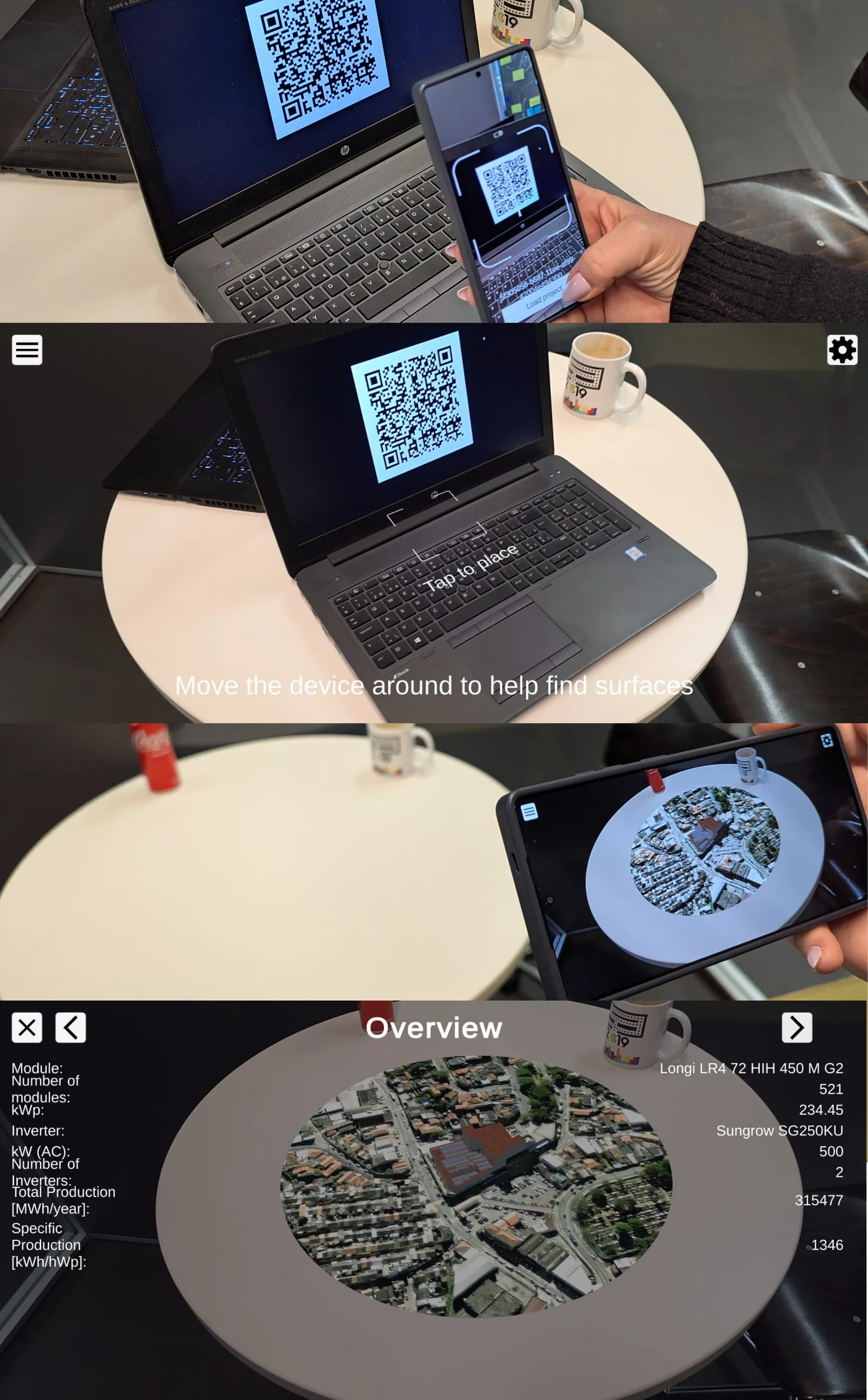
AR workflow showing QR code scanning, surface detection with visual guidance, 3D scene augmentation, and detail view
Architecture
Both apps share a Unity codebase: geometric modeling, visualization, interaction, project management, networking, and real-time sun simulation all live in one place, so a feature built for one platform carries over to the other.
The system pulls project data from Solextron's existing web-based design tool through its REST API: geospatial coordinates, building and panel meshes, and environmental data for shadow simulation. That gets deserialized and rebuilt into 3D models with custom mesh builders and lighting.
Augmented Reality
The AR app turns a phone into a spatial viewer for walking around a layout on-site. Built with Unity 2022.3 LTS and Vuforia Engine, using markerless tracking, geographic data, and real-time sun simulation.
AR features:
- QR Code Integration: Loads a project straight from Solextron's web platform
- Geographic Context: Terrain data from ArcGIS for accurate placement
- Interaction: Pinch-to-zoom, drag and tap controls
- Mobile Optimization: Custom shaders and static batching to keep frame rate steady on midrange Android phones
- Real-time Sun Simulation: Shadows update based on location and time of day
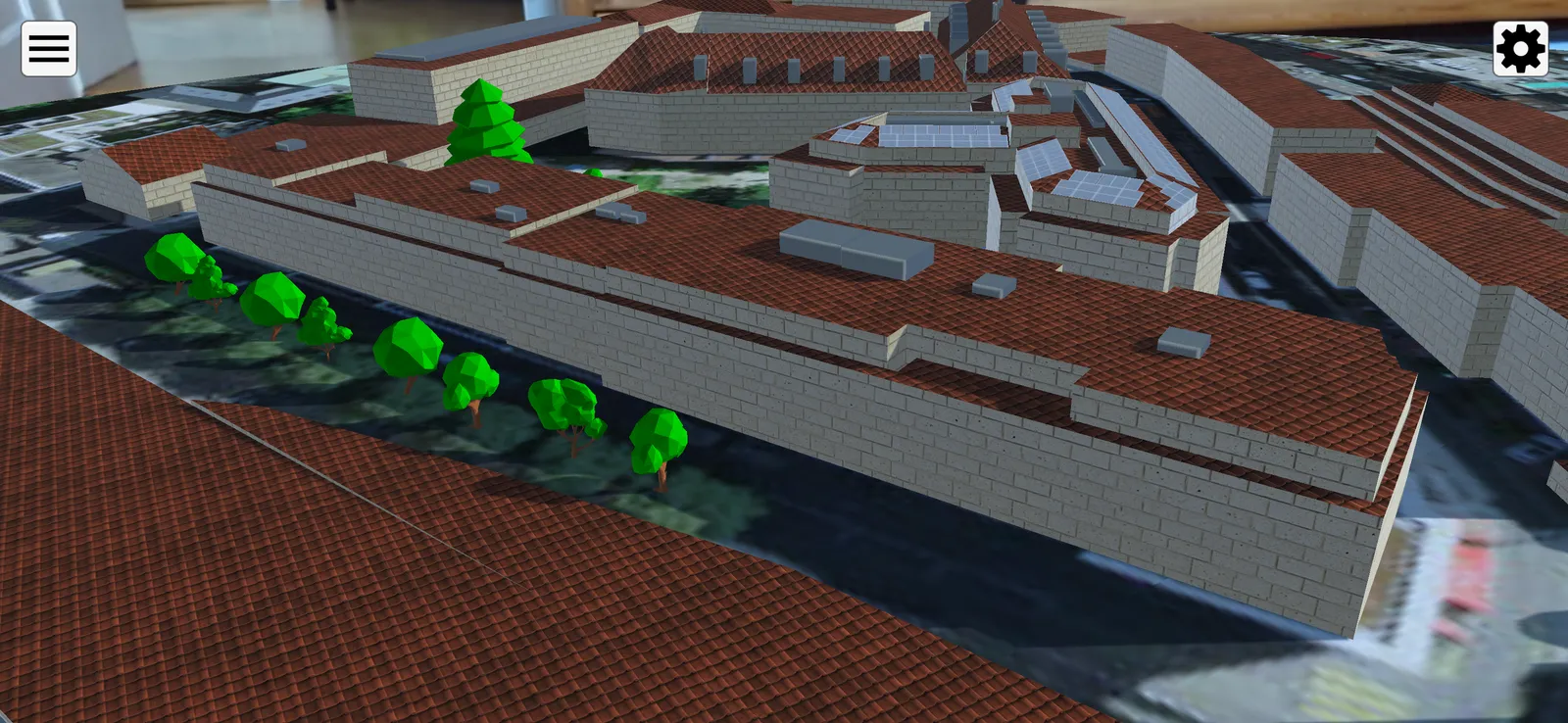
Close-up of a panel layout in the AR app
Virtual Reality
The VR app is for walking through a layout together with other people. It targets standalone Meta Quest headsets and shares its data pipeline and mesh generation with the AR app.
VR features:
- Multi-user Collaboration: Photon PUN2 networking for shared sessions
- Synchronized Interactions: Customization events sync over RPCs
- Performance: Custom GPU instancing shaders render thousands of panel support structures with little overhead
- Navigation: Thumbstick teleportation instead of smooth locomotion, to avoid motion sickness
- Material Customization: Ray-cast pointer for roof materials, facades and panel styles
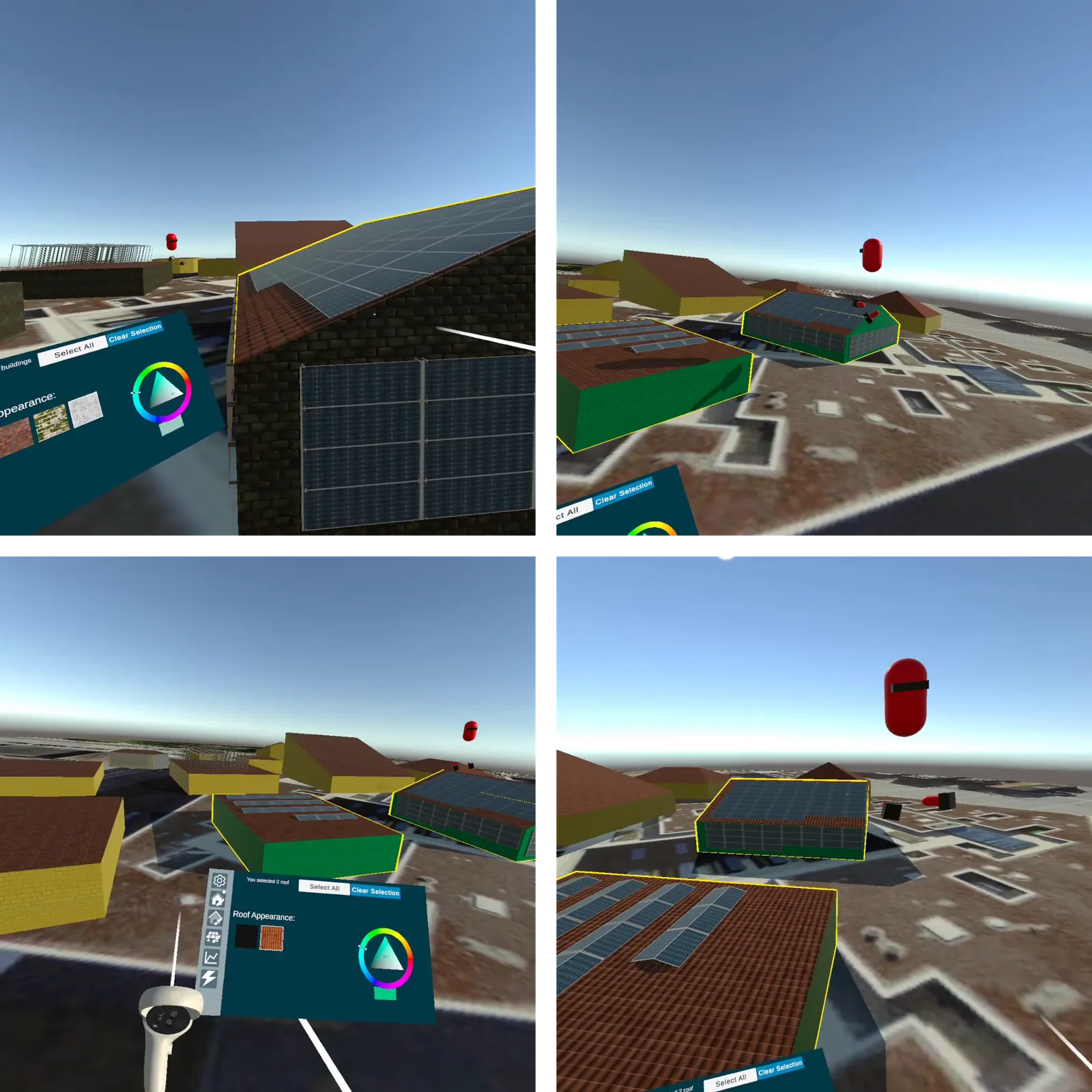
VR screenshots showing the controller menu, building selection, and multi-user collaboration with visible participant avatars
Performance
The VR app holds 90-120fps on Quest hardware through mesh instancing, occlusion culling, and single-pass stereo rendering in Unity's URP. The AR app runs consistently across midrange Android devices and is live in open testing on the Play Store.
Tech Stack
- AR Development: Unity 2022.3 LTS, Vuforia Engine, ArcGIS SDK, mobile-optimized shaders
- VR Development: Unity, Photon PUN2, Unity XR Interaction Toolkit, OpenXR runtime, Meta Quest SDK
- Backend Integration: Solextron web platform APIs, RESTful services, QR code data retrieval
- Performance Optimization: GPU instancing shaders, occlusion culling, Unity URP, single-pass stereo rendering
Publications
Hüsser, C., Fluri, L., & Cords, H. (2026). Immersive and Collaborative 3D Solar Panel Visualization Through XR. In IADIS International Journal on WWW/Internet (Vol. 24, No. 1, pp. 112-125). ISSN: 1645-7641.
Hüsser, C., Fluri, L., & Cords, H. (2025). Interactive 3D visualization and configuration of solar panel layouts in XR. In K. Helin, B. Schiavi, & E. Tsaknaki (Eds.), EuroXR 2025: Proceedings of the Application, Poster, and Demo Tracks of the 22nd EuroXR International Conference (VTT Technology No. 440). VTT Technical Research Centre of Finland.
Hüsser, C., Fluri, L., & Cords, H. (2025). An Extended Reality Approach to Interactive 3D Visualization and Configuration of Solar Panels. In Proceedings of the 22nd International Conference on Applied Computing.